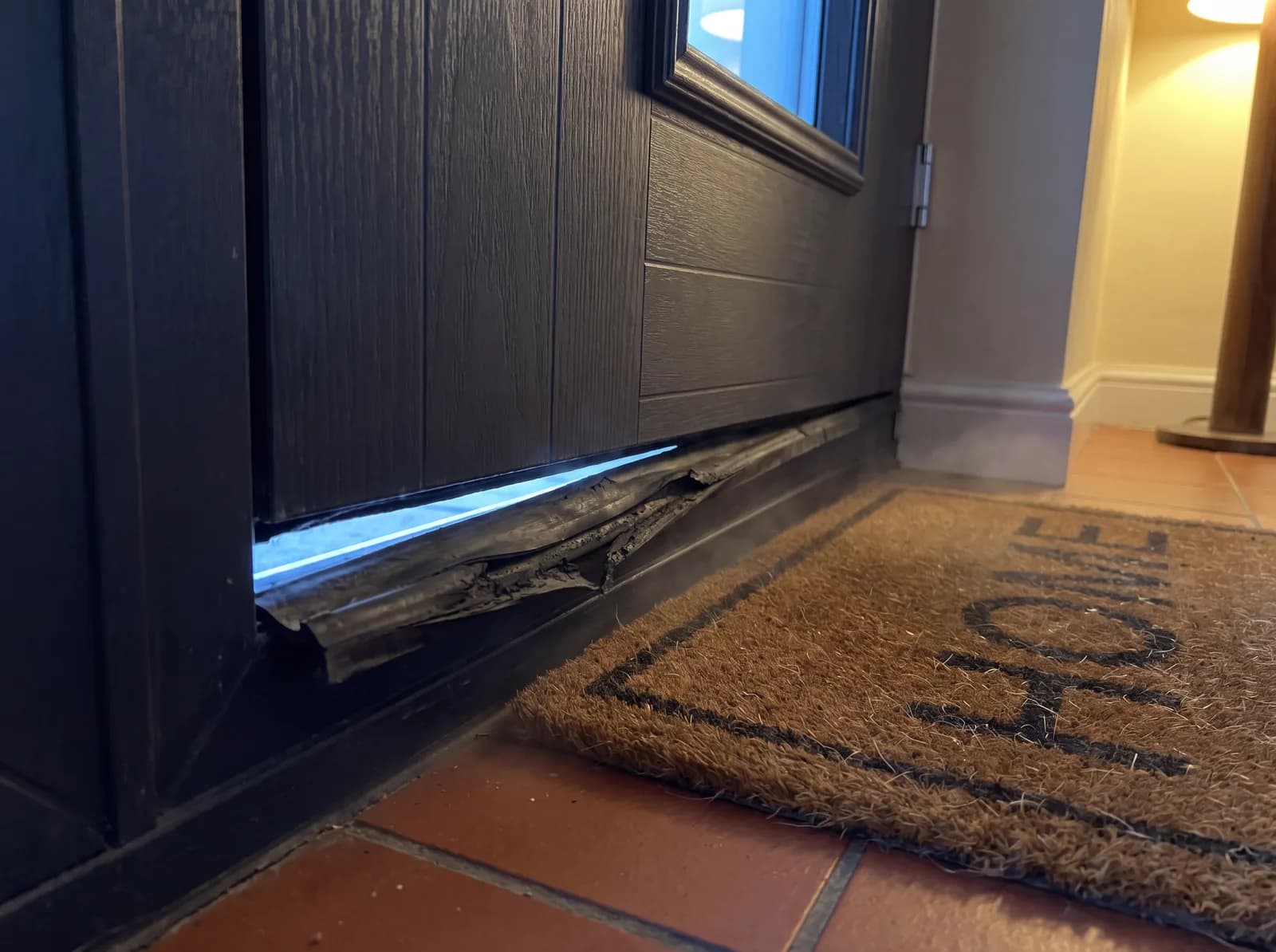
1. Do the paper test on the seals
Close the door on a sheet of paper at a few points around the frame: top, middle and bottom on both sides. If it slides out with no grip, the rubber seal is not pressing against the door at that point.
Flattened, cracked or missing seals are a common cause of winter draughts, and on most uPVC and composite doors the seals can be replaced.
2. Check whether the door has dropped
Over time, doors can sag on their hinges. Signs include the door catching on the frame at the bottom, uneven gaps around the edge, or the key and handle getting harder to turn.
Most uPVC and composite doors have adjustable hinges, so a dropped door can often be lifted back into line rather than replaced.
3. Do not force a stiff handle
If you have to lean on the handle to lift it and lock up, the door is out of alignment and the locking points are dragging. Forcing it every day is one of the most common ways the gearbox in a multi-point lock fails, and a failed lock can leave a door that will not open or will not lock.
A stiff handle in autumn is the cheap warning. Getting the door adjusted then costs far less than a locked-out emergency in January.
4. Look at the letterbox
A plain letterbox flap lets in a steady stream of cold air. An internal brush or draught-proof letterbox cover is a simple fix, and it also makes it harder for anyone to reach through towards keys.
5. Check the threshold
Look at the bottom of the door with the lights off inside on a bright day. If you can see daylight under it, or feel air along the floor, the threshold seal or weather bar may be worn or damaged.
When to call someone
Seals and letterbox brushes are simple jobs. Call someone in if the door has dropped, the lock is stiff or the handle has gone floppy, the frame is moving, or you have done the checks and still feel cold air coming through.
Sutton, London & Surrey
Want it looked at properly?
Send a photo on WhatsApp or book a free, no-obligation visit. We quote the repair first wherever it makes sense.
Quick answers
Why is my front door draughty?
Most draughts come from worn or flattened seals, a door that has dropped on its hinges, an unprotected letterbox or a worn threshold seal. All four can usually be fixed without replacing the door.
Why is my uPVC door hard to lock?
Usually because the door has moved out of alignment, so the locking points drag on the frame. The hinges and keeps can normally be adjusted. Avoid forcing the handle, as that can break the multi-point lock gearbox.